
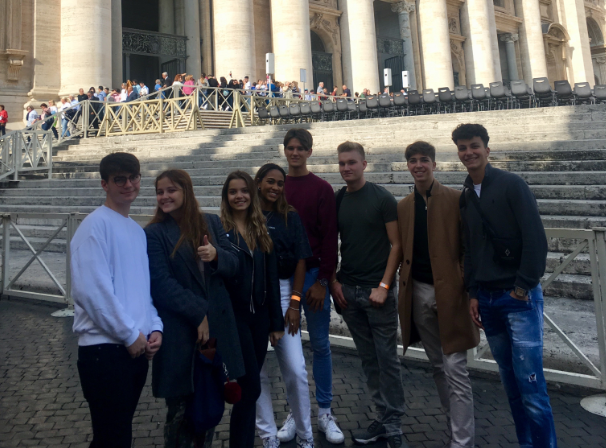
On a particularly cold Monday morning, eight students of Classics and Religious Studies met with myself and Mr Nick Russell (who kindly stepped in for Mr George Greenbury) to embark on an educational tour of Rome.
Upon arriving in the Eternal City, we made the most of the glorious weather and took in some of the main sites of the city on foot, meandering down to Piazza Navona to enjoy a leisurely dinner. Our first full day in Italy required an early start to reach the Vatican City in time for our guided tour of the Vatican museums, the Sistine Chapel and St Peter’s basilica. We enjoyed a wonderfully engaging tour of the museums and learnt a lot about the progression of religion in Rome from pagan beliefs to Catholicism.
In the afternoon, we made our way to the Colosseum where Oliver Healy-Millett (P) and Sandro Celebidachi (F) gave an informed presentation on both the structure of the amphitheatre and the gladiatorial games that had taken place within it. In the evening, we explored the area around Piazza della Repubblica before making our way to the Trevi Fountain for dinner.
On the third day, we travelled beyond the city walls to the Catacombs of San Sebastian where we were able to compare the burial rituals of pagans and Christians and see the burial sites of three martyrs, including a shrine to Saint Sebastian. We then returned to the city to explore the remains of the Baths of Caracalla where VR headsets allowed us to picture the grandeur of the original buildings. Our final stop of the day was the Pantheon – a Roman temple converted into a Catholic Church – where Emily Vandrau (R) explained the key features of the design and history of the building.
In the evening, we took in the church of Santa Maria della Vittoria and in particular studied Bernini’s statue of the Ecstasy of Saint Teresa (about which Mr Nick Russell proved to be somewhat of an expert) before heading back to Piazza Navona for our final dinner.
Our last day started with the spectacularly decorated Basilica Papale di Santa Maria Maggiore before exploring the extensive collection of Ancient Roman art and artefacts in the Capitoline Museum where Ayah Shehata (Cr) and Kaya Mirtcheva (Cr) gave a well-prepared presentation on the statue of philosopher and emperor Marcus Aurelius. It was also an opportunity to enjoy expansive views of the city from the terraces at the top of the museum before a final Italian lunch and our return to the UK.
The students were excellent company on what was a busy trip full of opportunities to develop their understanding of their A-level studies, organised by Mr George Greenbury.
By Jess Saul, Head of Classics


